

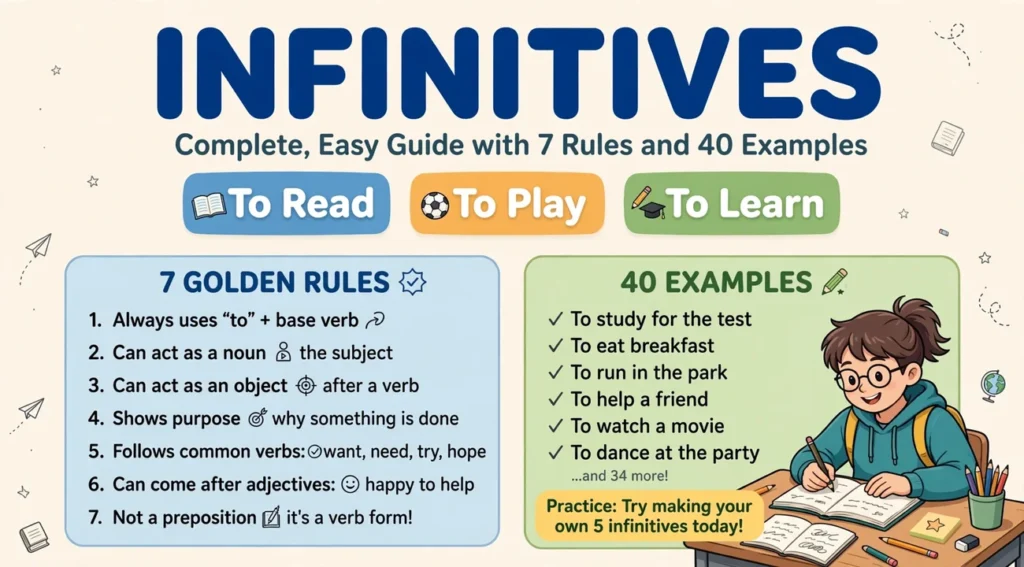
An infinitive is one of the simplest verb forms in English, and you use it every day. When you say “I want to learn English” or “She likes to read books,” the words “to learn” and “to read” are infinitives. This GrammarLuck guide shows what they are and how to use them right.
Here is the short answer. An infinitive is the base form of a verb, usually with “to” in front of it: to eat, to sleep, to play. Infinitives can work as a noun, an adjective, or an adverb, and they never change form. You never add -s, -ed, or -ing to them.
In this guide, you will learn the two kinds of infinitives, the 7 simple rules, a 2-second trick, 40 examples, the most common mistakes, and a quick quiz. Then you will use them with confidence in essays, emails, and exams.
Infinitives: The Quick Answer
The fastest way to understand infinitives is to see the two kinds side by side.
| Form | What it looks like | Example |
|---|---|---|
| To-infinitive | to + base verb | I want to swim. |
| Bare infinitive | base verb, no “to” | She can swim. |
| Gerund | verb + -ing | Swimming is fun. |
The golden rule is simple: use “to” + base verb after most verbs, and the bare form after can, will, and must. Not sure? Ask if the verb before it needs “to.”
What Are Infinitives?

An infinitive is the base form of a verb, with no ending: eat, not eats or eating; go, not goes or going. Put “to” in front and you get the to-infinitive: to eat, to go, to learn. Here, “to” is part of the infinitive, not a preposition.
Infinitives do not show tense. “I wanted to swim” and “I want to swim” both use “to swim,” though one is past and one is now. The main verb shows the time, and the infinitive stays the same.
- She wants to read a new book.
- They like to play football.
- He needs to rest today.
- We hope to win the match.
- I am learning to drive a car.
Every infinitive starts from a verb. If you are unsure about verb forms, read our guide to verbs first.
Infinitives as Subjects and Objects
Infinitives can do the job of a noun. An infinitive can be the subject — the thing the sentence is about — or the object — the thing that receives the action.
| Role | Example | Job in the sentence |
|---|---|---|
| Subject | To swim is good exercise. | subject |
| Subject | To wait is hard. | subject |
| Object | I love to sing. | object |
| Object | He forgot to call his friend. | object |
As a subject, the infinitive comes first, followed by is, takes, or seems. As an object, it comes after the main verb.
Because infinitives can act like nouns, they often take the place of one. Our guide to nouns shows how.
Infinitives After Verbs
Some verbs always take a to-infinitive, never the -ing form: want, need, decide, plan, hope, agree, learn, and try. “I want to go” is right; “I want going” is wrong.
| Verb | Example |
|---|---|
| want | I want to rest. |
| decide | They decided to stay. |
| hope | We hope to win. |
| plan | She plans to study hard. |
| learn | He is learning to drive. |
| agree | We agreed to meet at noon. |
Other verbs take an object first — ask, tell, teach, allow, invite: “She asked me to help” and “He taught us to swim.”
Most of these verbs appear in the present simple tense. Our guide to the present simple tense shows how they work.
Bare Infinitives
A bare infinitive is the base verb with no “to” in front of it. Use it after can, could, will, would, shall, should, may, might, and must. “She can swim” is right; “She can to swim” is wrong. Use it after let, make, and help too.
Bare infinitives also follow do in questions and negatives: “Do you like tea?” and “She does not know the answer.” The verb stays in its base form because a helper word does the grammar work. After can, will, must, let, and make, the verb never takes “to.”
You will meet the bare infinitive most in future sentences. Our guide to the future simple tense shows this pattern.
7 Simple Infinitive Rules
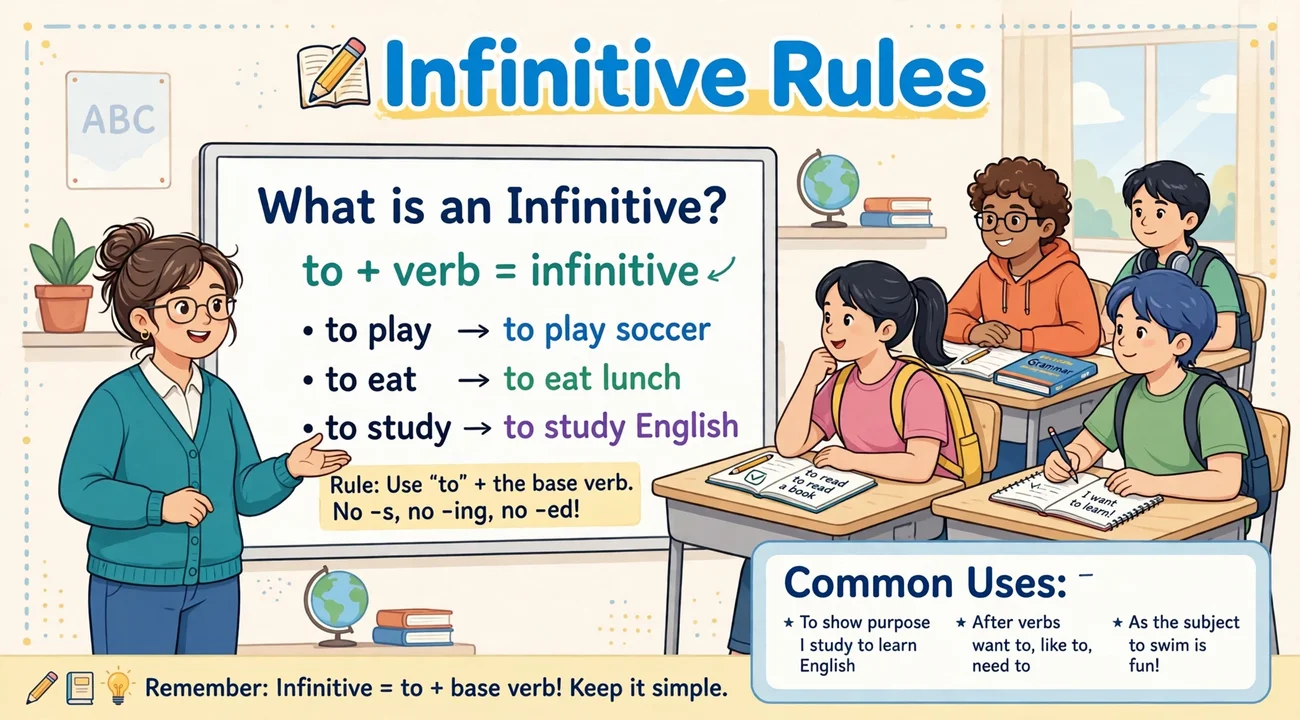
These seven rules cover the infinitives you use every day.
Rule 1: Use To + Base Verb After Want, Need, and Decide
After want, need, decide, hope, and plan, always use “to” + the base verb. “I need to sleep” is right; “I need sleeping” is wrong.
Rule 2: Use the Bare Form After Modal Verbs
After can, could, will, would, may, might, must, and should, use the base verb with no “to”: “They will come tomorrow” and “You must try again.”
Rule 3: Use the Bare Form After Let and Make
“Let me go” and “She made him cry” use the bare form, not “to go” or “to cry.” Remember the pair: let + base verb, make + base verb.
Rule 4: Never Take -s, -ed, or -ing
Infinitives never change their form. Say “to play,” never “to plays” or “to played.” The main verb shows the tense.
Rule 5: Use a To-Infinitive to Show Purpose
To say why you do something, use a to-infinitive: “I came here to learn English.” “She went to the shop to buy milk.”
Rule 6: Use an Infinitive After Adjectives
After happy, glad, easy, hard, and ready, use a to-infinitive: “I am happy to help.” “This book is easy to read.” The pattern is simple: adjective + to + base verb.
Rule 7: Do Not Split the Infinitive with Long Words
A split infinitive puts a word between “to” and the verb, like “to quickly run.” Short splits are fine daily, but in exams keep “to” and the verb together: “to run quickly” is safer.
The 2-Second Trick to Spot an Infinitive
Not sure if a word is an infinitive? Ask: can I put “to” in front of it? “To read” works, but “to happily” does not. The word after “to” must be a base verb.
Step 1: Find “to” in the sentence.
Step 2: Is the next word a base verb?
Step 3: If yes, you found an infinitive. If no, it is not one.
Try the trick on these examples:
- “She wants to sing.” ✅ “To sing” is an infinitive.
- “She wants to happily.” ❌ “To happily” is not one, because “happily” is not a verb.
- “They can swim.” ✅ “Swim” is a bare infinitive after “can.”
- “They can to swim.” ❌ “To” does not belong after “can.”
Use this trick for one week, and spotting them will become a habit.
40 Infinitives Examples
Here are 40 simple examples. The first 20 use ‘to’ + base verb, and the next 20 use the bare form.
To-form:
- I want to learn English.
- She likes to read books.
- They decided to stay at home.
- We hope to win the match.
- He needs to rest today.
- I came here to study.
- She went to buy milk.
- They plan to visit London.
- He agreed to help us.
- We are happy to see you.
- This book is easy to read.
- I am ready to go now.
- She forgot to call her friend.
- He tried to open the door.
- We want to play football.
- The children love to sing songs.
- I need to buy some bread.
- She asked me to wait.
- He taught us to swim.
- They promised to come back soon.
Bare form:
- She can swim very well.
- They will come tomorrow.
- You must try again.
- He can speak three languages.
- Let me go home.
- She made him cry.
- Help me carry this bag.
- We should leave now.
- He could run very fast.
- They might visit us today.
- I will help you.
- She does not know the answer.
- Do you like tea?
- You may sit here.
- We must finish our homework.
- He would help us.
- Let her speak first.
- They made us laugh.
- She can dance very well.
- We will meet again soon.
For trusted reference reading, the Grammarly guide explains the same rules with more examples.
Common Infinitives Mistakes
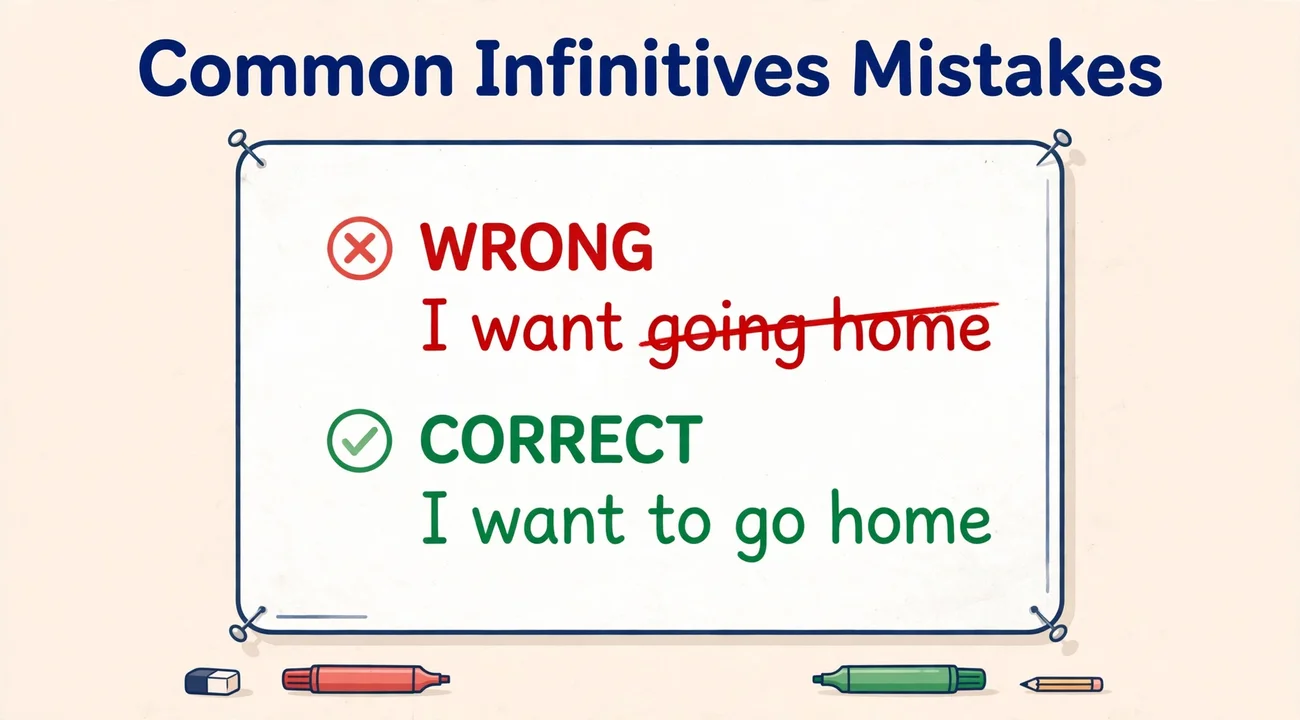
Even good students make these five common mistakes with infinitives. Learn them once and avoid them forever.
Mistake 1: Using -ing after want.
Wrong: “I want going home.” Right: “I want to go home.” After want, use “to” + base verb.
Mistake 2: Adding “to” after can.
Wrong: “She can to swim.” Right: “She can swim.” Modals take the bare form, never “to.”
Mistake 3: Adding -s to the infinitive.
Wrong: “He wants to goes.” Right: “He wants to go.” It never takes -s.
Mistake 4: Leaving out “to” after decide.
Wrong: “They decided stay.” Right: “They decided to stay.” After decide, “to” is part of the pattern.
Mistake 5: Splitting the infinitive in formal writing.
Wrong: “To very quickly finish the work is hard.” Right: “To finish the work very quickly is hard.”
Practise the right forms in real sentences. Our simple English sentences give you hundreds of patterns to copy.
Quick Quiz: Test Yourself
Choose the correct form for each sentence. Answers are at the end — no peeking!
- I want ___ English. (to learn / learning)
- She can ___ very well. (to swim / swim)
- They decided ___ at home. (to stay / stay)
- You must ___ again. (to try / try)
- He is learning ___ a car. (to drive / drive)
- Let me ___ home. (to go / go)
- We hope ___ the match. (to win / win)
- She made us ___. (to laugh / laugh)
Answers:
1. to learn (after want)
2. swim (after can)
3. to stay (after decide)
4. try (after must)
5. to drive (after learning)
6. go (after let)
7. to win (after hope)
8. laugh (after make)
8/8 — excellent! 6–7 — very good. Fewer than 6 — read the 7 rules once more.
Want more practice? Try our grammar exercises every day.
Infinitives Quick Summary
| Point | What to remember |
|---|---|
| What is an infinitive? | to + base verb |
| Two kinds | to-infinitive and bare infinitive |
| After want, decide, hope | to + base verb |
| After can, will, must | bare form, no “to” |
| After let and make | bare form, no “to” |
| Never changes | no -s, -ed, or -ing |
| Shows purpose | I came to learn. |
Keep this summary near your desk. The more you use infinitives, the faster they will feel natural.
FAQs About Infinitives
What is an infinitive in simple words?
Infinitives are the base form of a verb, usually with “to” in front, like to eat and to play. They can work as a noun, adjective, or adverb.
What is the difference between an infinitive and a gerund?
An infinitive is “to + base verb” (to swim); a gerund is “verb + -ing” (swimming). After want and decide, use the infinitive; after enjoy and finish, the gerund.
What is a bare infinitive?
A bare infinitive is the base verb with no “to”: “She can swim.” Use it after can, must, let, make, and help.
Can infinitives be the subject of a sentence?
Yes. In “To learn takes time,” “to learn” is the subject. It does the same job as a noun.
Do they show tense?
No. In “I wanted to swim” and “I want to swim,” it stays the same. The main verb shows the time.
How can I practise infinitives every day?
Write five sentences a day with a to-infinitive and five with a bare one. Read them aloud, and check them with the 7 rules above.
Conclusion
Infinitives are small verb forms with a big job. They show purpose, follow verbs like want and decide, and stay the same in every tense. Learn the two kinds, and remember the bare form after can and must.
Practise with the examples and quiz here, and soon you will use infinitives without thinking. Keep learning with GrammarLuck.
