

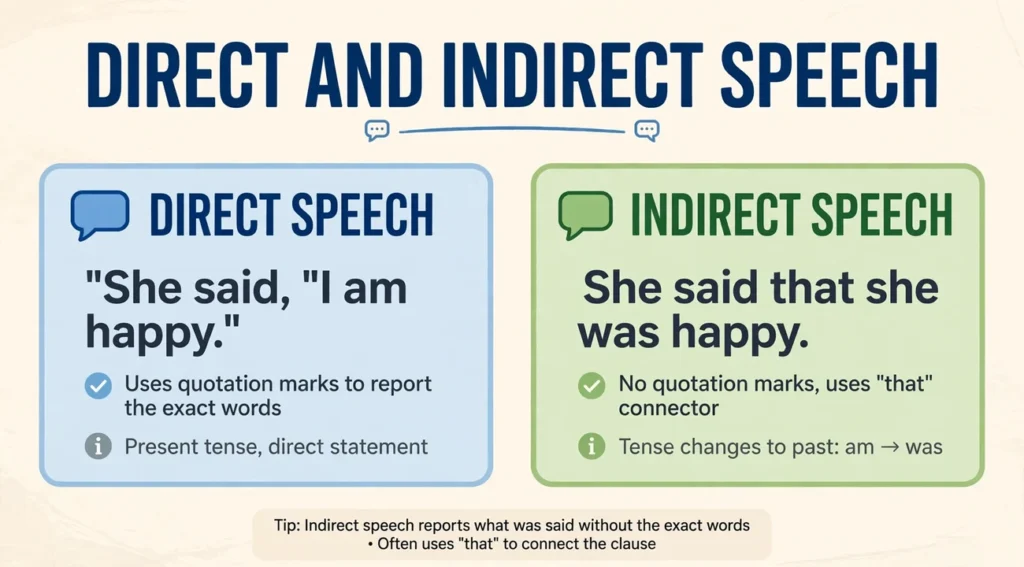
Sara said, “I love this book.” Later, Ali tells someone: “Sara said that she loved that book.” This is the heart of Direct and Indirect Speech.
Here is the short answer. Direct speech repeats the exact words of a speaker in quotation marks. Indirect speech reports what the speaker said, without their exact words. In direct and indirect speech, the meaning stays the same, but the tense and the pronouns change.
In this complete guide, you will learn what direct speech is, what indirect speech is, 7 simple rules, a 2-second trick, 40 direct and indirect speech examples, common mistakes, and a quick quiz. By the end, direct and indirect speech will feel easy.
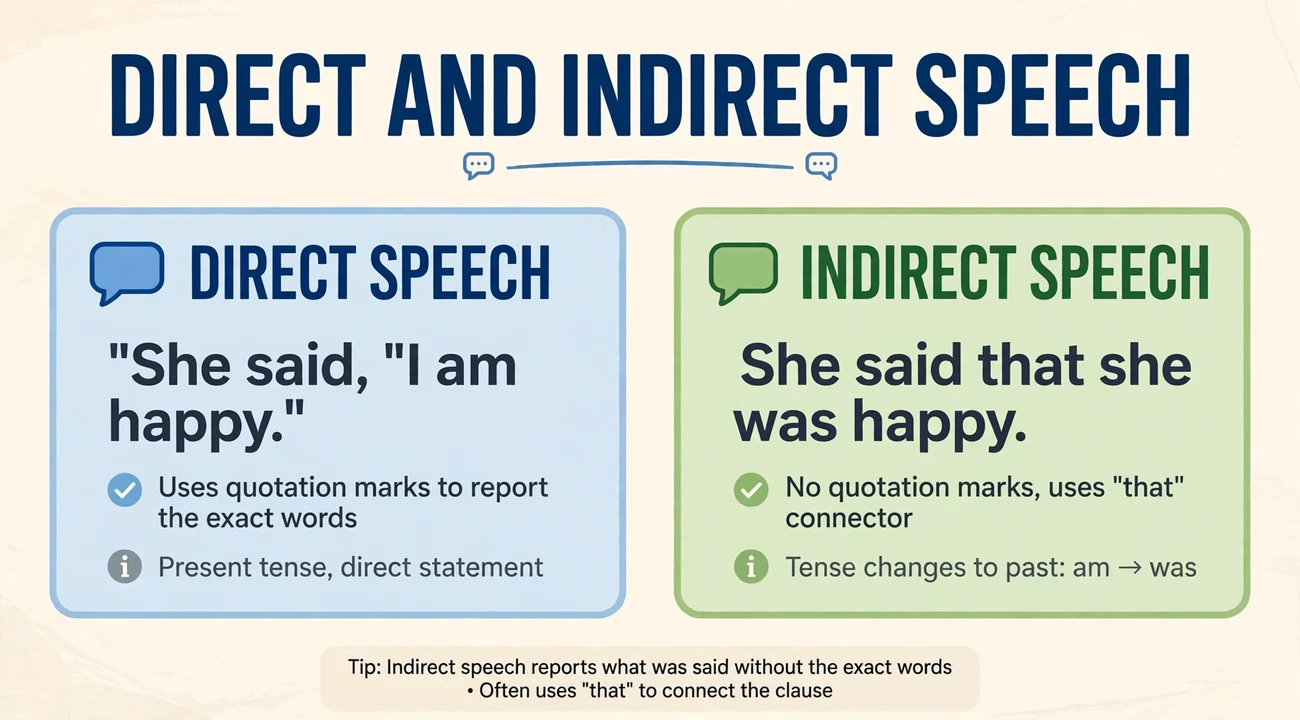
Direct and Indirect Speech: The Quick Answer
Compare the two forms side by side to understand direct and indirect speech.
| Direct speech | Indirect speech | Example |
|---|---|---|
| Exact words in quotes | Reported meaning, no quotes | “I am hungry.” → He said that he was hungry. |
| Present tense is common | Past tense is common | “I like tea.” → She said that she liked tea. |
| I, my, here, today | He, his, there, that day | “I am here.” → He said that he was there. |
Direct speech quotes, indirect speech reports. Quotation marks mean direct speech, and the word that means indirect speech.
What Is Direct Speech?
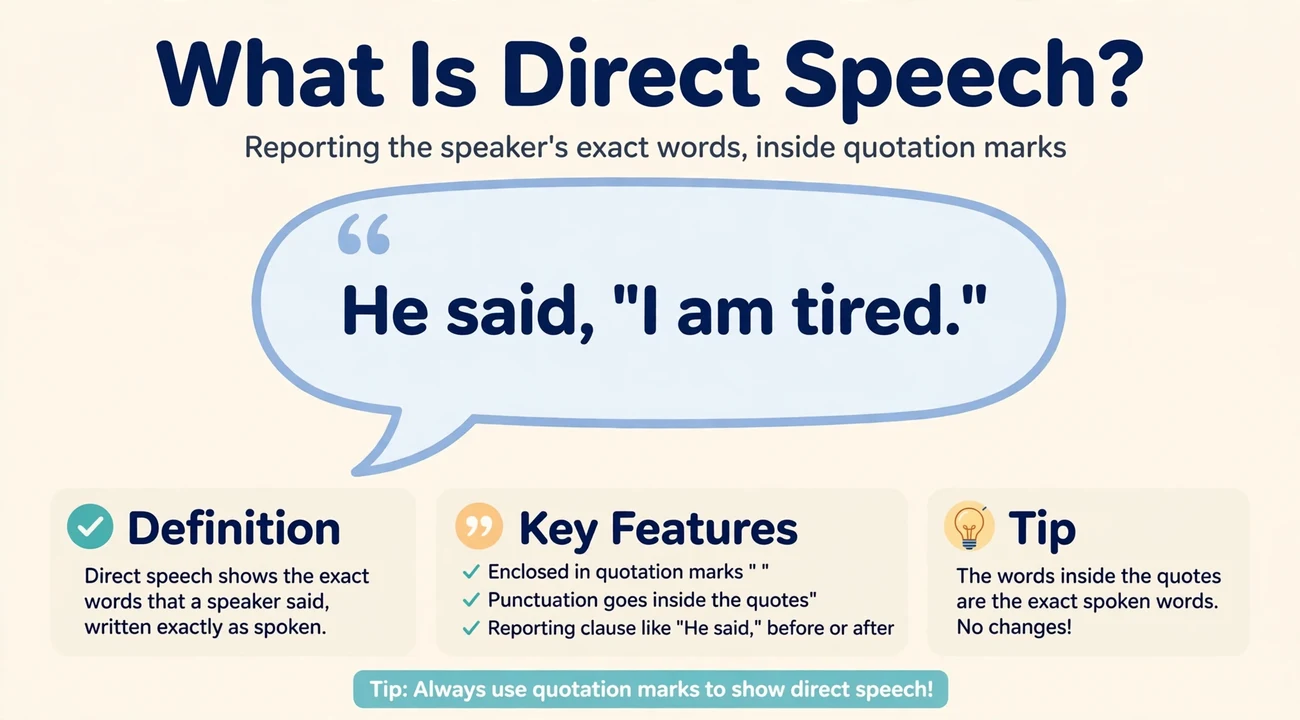
Direct speech repeats the exact words that a person said, inside quotation marks (” “).
- He said, “I am tired.”
- “I will come tomorrow,” she said.
- The teacher said, “Sit down.”
- Ali said, “I like apples.”
- “Where are you going?” asked Sara.
In direct speech, the words inside the quotes are the speaker’s own words. See our guide to types of sentences.
Direct speech is common in stories and plays, because it feels alive. That is why direct and indirect speech matter so much.
What Is Indirect Speech?
Indirect speech, also called reported speech, tells us what a person said without their exact words. We use that to join the parts, and we change the tense and the pronouns.
- He said that he was tired.
- She said that she would come the next day.
- The teacher said to sit down.
- Ali said that he liked apples.
- Sara asked where I was going.
“I am tired” becomes “he was tired.” This is called backshift.
We use three main reporting verbs: said, told, and asked. See our guide to verbs.
7 Simple Direct and Indirect Speech Rules
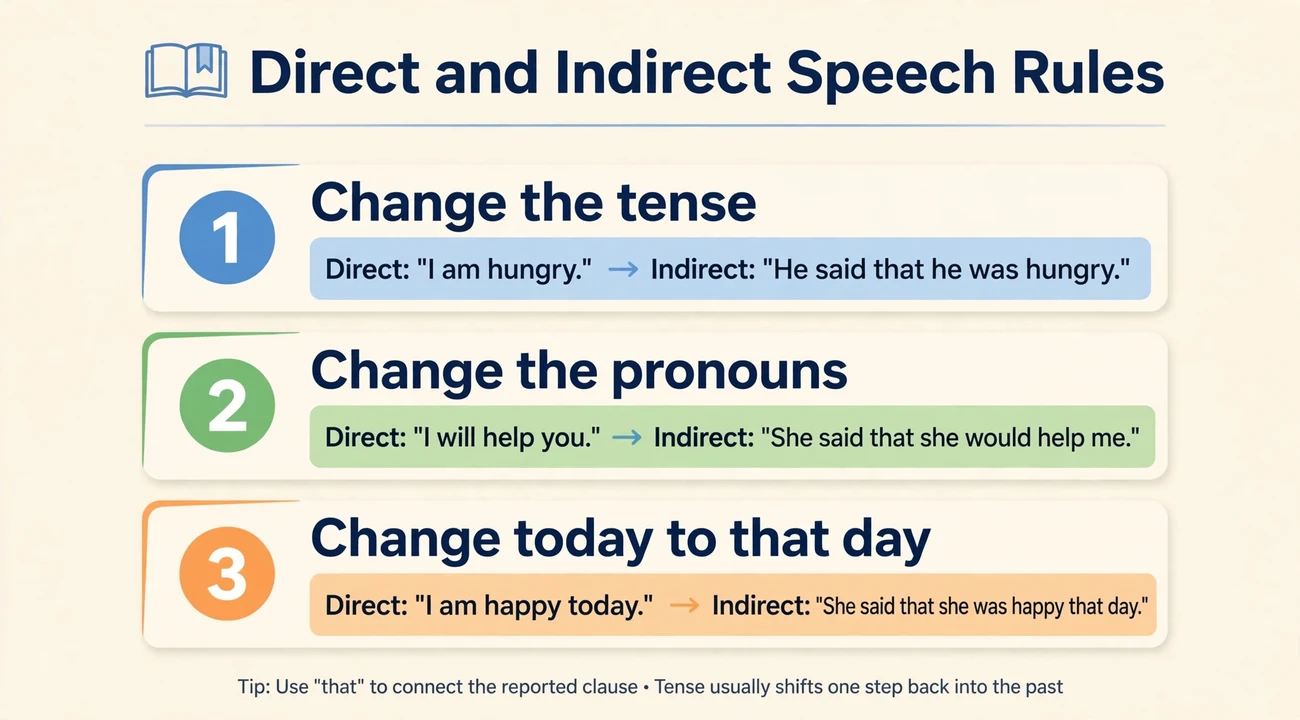
These 7 rules cover everything you need for direct and indirect speech.
Rule 1: Change the Tense
When the reporting verb is in the past, the tense moves one step back: present simple becomes past simple, and will becomes would. This is the key rule of direct and indirect speech.
- “I play football.” → He said that he played football.
- “We will win.” → They said that they would win.
See our guides to present simple tense and past simple tense.
Rule 2: Change the Pronouns
Pronouns change to fit the new speaker: I becomes he, my becomes his, we becomes they. See our guide to pronouns.
- “I lost my bag.” → She said that she had lost it.
- “We are happy.” → They said that they were happy.
Rule 3: Change Time and Place Words
Today becomes that day, tomorrow becomes the next day, yesterday becomes the day before, and here becomes there.
- “I will come.” → He said that he would come.
- “I am here.” → She said that she was there.
Rule 4: Change Questions
To report a question, use asked, and do not use a question mark. Use if or whether for yes/no questions, and keep the wh-word.
- “Are you ready?” → He asked if I was ready.
- “Where do you live?” → She asked where I lived.
Rule 5: Change Commands and Requests
To report a command or a request, use told or asked plus to and the base verb.
- “Sit down.” → The teacher told us to sit down.
- “Please help me.” → She asked me to help her.
Rule 6: Say or Tell
Use said when you do not name the listener, and told when you do. Never write “said me.”
- “I am busy,” he said. → He said that he was busy.
- “I am busy,” he said to me. → He told me that he was busy.
Rule 7: No Quotation Marks
Indirect speech never uses quotation marks, because it does not repeat the exact words. See our guide to prepositions.
- “I am happy.” → He said that he was happy.
- “I know the answer.” → Ali said that he knew the answer.
The 2-Second Direct and Indirect Speech Trick
Still not sure? Use this quick trick. It takes only two seconds.
Step 1: Ask: “Am I quoting the exact words or reporting the meaning?”
Step 2: Quotation marks and exact words mean direct speech.
Step 3: Reported words with that mean indirect speech.
Try the trick on these examples:
- “I am late.” → Exact words — direct speech.
- “He said that he was late.” → Meaning reported — indirect speech.
- “Are you coming?” → Exact question — direct speech.
- “She asked if I was coming.” → Reported question — indirect speech.
Run this test every time you feel stuck, and direct and indirect speech will stop confusing you.
40 Direct and Indirect Speech Examples
Here are 40 direct and indirect speech examples: 20 statements, then 20 questions, commands, requests, and exclamations. For trusted reference reading on this topic, the Wikipedia page on reported speech explains the same ideas with extra detail.
Statements (1–20):
- “I am late.” → He said that he was late.
- “I like tea.” → She said that she liked tea.
- “I play.” → Ali said that he played.
- “I read.” → Sara said that she read.
- “We will come.” → They said that they would come.
- “You are good.” → He said that we were good.
- “I did it.” → He said that he had done it.
- “I can swim.” → She said that she could swim.
- “I cook.” → Ali said that he cooked.
- “I saw it.” → He said that he had seen it.
- “I want it.” → Sara said that she wanted it.
- “We live.” → They said that they lived.
- “I must go.” → He said that he had to go.
- “I learn.” → She said that she learned.
- “I lost it.” → Ali said that he had lost it.
- “It is raining.” → He said that it was raining.
- “I will help.” → Ali said that he would help.
- “I have a cat.” → She said that she had a cat.
- “You need rest.” → He said that I needed rest.
- “I am happy.” → He said that he was happy.
Questions, commands, requests, and exclamations (21–40):
- “Are you ready?” → He asked if I was ready.
- “Where do you live?” → She asked where I lived.
- “Did you finish?” → He asked whether I had finished.
- “What is your name?” → He asked what my name was.
- “Will you come?” → Sara asked if I would come.
- “Why are you late?” → He asked why I was late.
- “Can you help?” → She asked if I could help her.
- “Open them.” → He told us to open them.
- “Please sit down.” → He asked me to sit down.
- “Clean it.” → Ali told me to clean it.
- “Do not touch.” → She told me not to touch it.
- “Show your card.” → He told me to show it.
- “Give water.” → He asked me to give him water.
- “Do not talk.” → He told us not to talk.
- “How nice!” → She said that it was very nice.
- “What a day!” → He said that it was lovely.
- “We won!” → Ali said with joy that they had won.
- “I lost it.” → She said with sorrow that she had lost it.
- “Live long!” → He wished that I might live long.
- “Work hard!” → He advised us to work hard.
Common Direct and Indirect Speech Mistakes
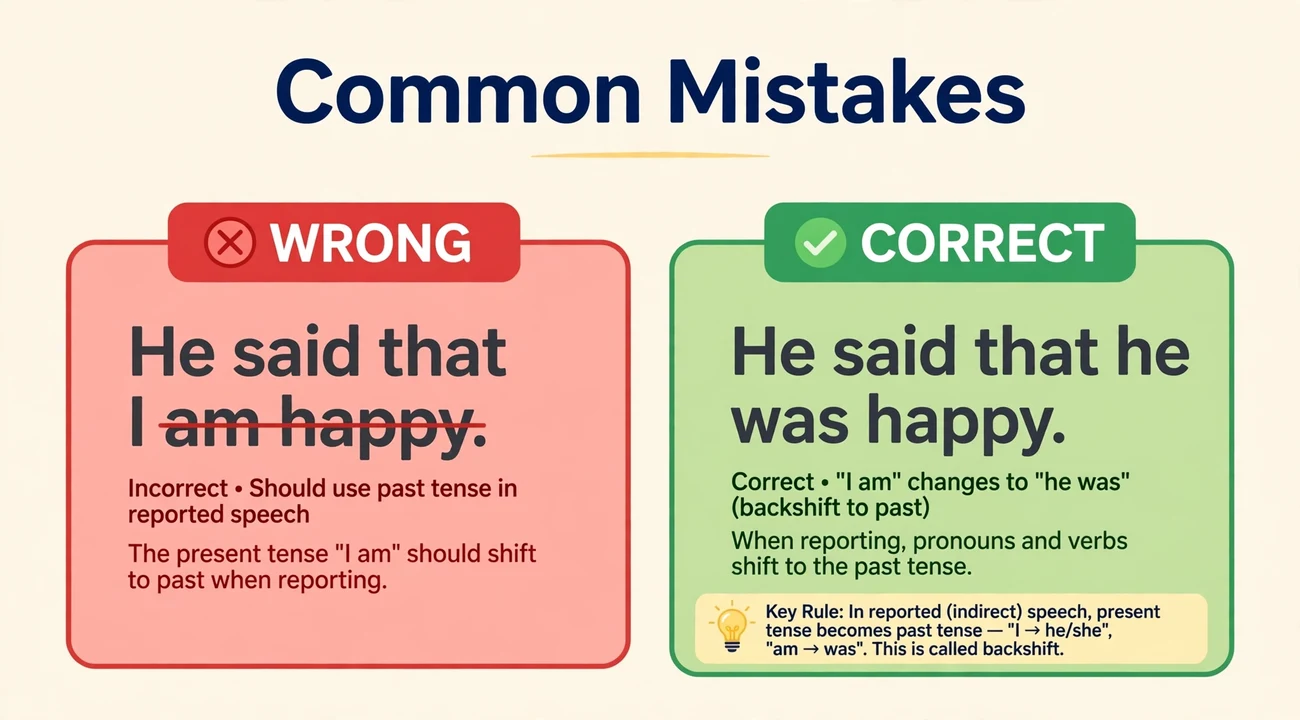
Even good learners make these mistakes with direct and indirect speech. Learn them once.
Mistake 1: Keeping the quotation marks.
Wrong: He said that “he was hungry.” Right: He said that he was hungry.
Mistake 2: Forgetting the tense change.
Wrong: He said that he is hungry. Right: He said that he was hungry.
Mistake 3: Writing “said me.”
Wrong: He said me that he was late. Right: He told me that he was late.
Mistake 4: Keeping the question word order.
Wrong: She asked where did I live. Right: She asked where I lived.
Mistake 5: Forgetting to change today and here.
Wrong: He said that he would come tomorrow. Right: He said that he would come the next day.
Quick Quiz: Direct and Indirect Speech
Change each sentence from direct to indirect speech.
- He said, “I am tired.”
- She asked, “Are you coming with me?”
- The teacher said, “Close the door.”
- Ali said, “I will call you tomorrow.”
- Sara said, “I bought this dress yesterday.”
Answers:
1. He said that he was tired.
2. She asked if I was coming with her.
3. The teacher told us to close the door.
4. Ali said that he would call me the next day.
5. Sara said that she had bought that dress the day before.
How did you do? 5/5 — excellent, you have mastered direct and indirect speech! 4 — very good. Fewer than 4 — read the rules once more and try again.
Direct and Indirect Speech Quick Summary
| Change | Direct | Indirect | Example |
|---|---|---|---|
| Quotation marks | Used | Not used | “I am happy.” → He said that he was happy. |
| Tense | Present simple | Past simple | “I play.” → He said that he played. |
| Pronoun | I, my, we | He, his, they | “I lost my pen.” → He said that he had lost it. |
| Time and place word | Today, here | That day, there | “I am here today.” → He said that he was there that day. |
| Question | Question order, “?” | Normal order, if/whether | “Are you ready?” → He asked if I was ready. |
| Command | “Sit down.” | Told + to + verb | “Sit down.” → He told me to sit down. |
Direct speech quotes, indirect speech reports. Keep this table until direct and indirect speech feel automatic.
FAQs About Direct and Indirect Speech
What is direct and indirect speech in simple words?
Direct speech repeats the exact words of a speaker: “I am hungry.” Indirect speech reports what the speaker said: He said that he was hungry.
What is the difference between direct speech and reported speech?
There is no real difference — reported speech is just another name for indirect speech.
Do we always change the tense in indirect speech?
Not always. In the present, the tense does not change. In the past, the tense moves one step back.
When do we use if or whether in indirect speech?
We use if or whether for a yes/no question: “Are you ready?” becomes “He asked if I was ready.” For wh-questions, we keep the wh-word.
What is the difference between say and tell?
Say does not name the listener: “He said that he was busy.” Tell always names the listener: “He told me that he was busy.”
How can I practise direct and indirect speech every day?
Take five sentences from your daily talk and change them from direct to indirect speech.
Conclusion
Direct and indirect speech are two ways to share what someone said. Direct speech quotes the exact words. Indirect speech reports the meaning and drops the quotation marks.
Learn the 7 rules and practise with the 40 examples above. Keep learning with GrammarLuck — grammar made simple.
