

Parallel structure is a grammar rule that makes your sentences clear, smooth, and easy to read. It means using the same form for two or more parts of a sentence that have the same job. In this guide to parallel structure, you will learn how to spot a broken pattern in seconds and fix it.
Here is the short answer. Parallel structure means that words in a list, a pair, or a comparison all use the same form. She likes reading, writing, and swimming. is parallel. She likes reading, writing, and to swim. is not – the last part breaks the pattern.
In this complete guide, you will learn what parallel structure is, why it matters, a 2-second test, 7 simple rules, 40 examples, common mistakes, and a quick quiz. By the end, parallel structure will never confuse you again.
Parallel Structure: The Quick Answer
The fastest way to understand it is to see a broken sentence next to the fixed one.
| Not Parallel | Problem | Parallel |
|---|---|---|
| She likes reading, writing, and to swim. | Last part is an infinitive | She likes reading, writing, and swimming. |
| He is smart, kind, and works hard. | Two adjectives, then a verb | He is smart, kind, and hard-working. |
| To win is better than losing. | An infinitive compared with an -ing word | Winning is better than losing. |
The golden rule is simple. Look at the parts that do the same job, and change any part that has a different form.
What Is Parallel Structure?
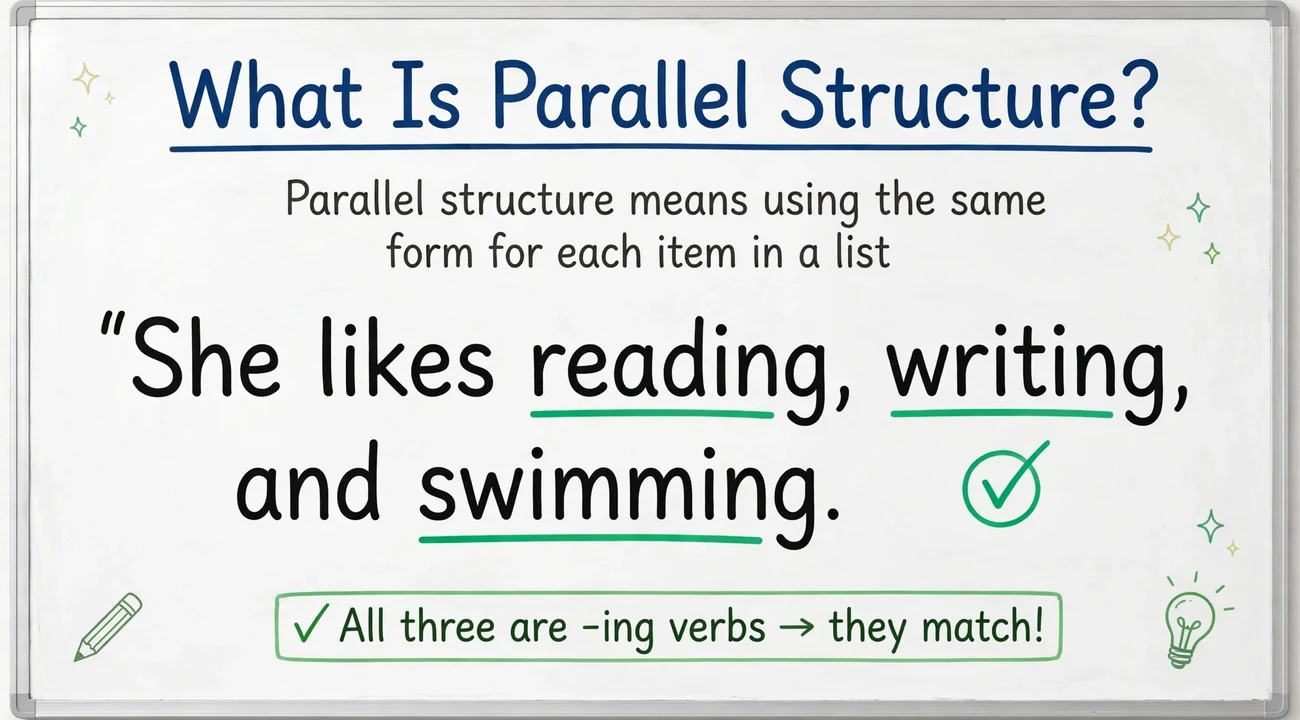
Parallel structure is a pattern in a sentence where two or more parts that share the same job use the same grammar form. The parts may be words, phrases, or clauses, but they must match. When the forms match, the sentence feels balanced.
Take I like to run, to jump, and to play. All three parts are infinitives, so the pattern is even. But I like to run, jumping, and to play. breaks the pattern, and the reader has to stop and work out what went wrong. That small break is a common mistake in student writing.
See our guide to types of sentences.
| Form | What It Means | Example |
|---|---|---|
| Two nouns | Two things with the same job | Cats and dogs are pets. |
| Two adjectives | Two words that describe one thing | She is kind and brave. |
| Two -ing words | Two actions in the same form | Reading and writing are fun. |
In parallel structure, each form has a job: the parts must match in shape, not just in meaning. A noun must match a noun, and an -ing word must match an -ing word. Break the match, and the sentence feels off.
The 2-Second Parallel Structure Test
Still not sure? Use this quick test. It takes only two seconds, and it finds a broken pattern in any sentence.
Step 1: Find the list, pair, or comparison. Step 2: Check the form of each part. If one form is different, you have found the break.
Try the test on these examples:
- She likes reading, writing, and to swim. – The last part is an infinitive, not an -ing word.
- She likes reading, writing, and swimming. – All three parts are -ing words.
- He is smart, kind, and works hard. – The last part is a verb, not an adjective.
- He is smart, kind, and hard-working. – All three parts are adjectives.
This trick never fails. When you feel stuck, look at the forms.
7 Simple Parallel Structure Rules
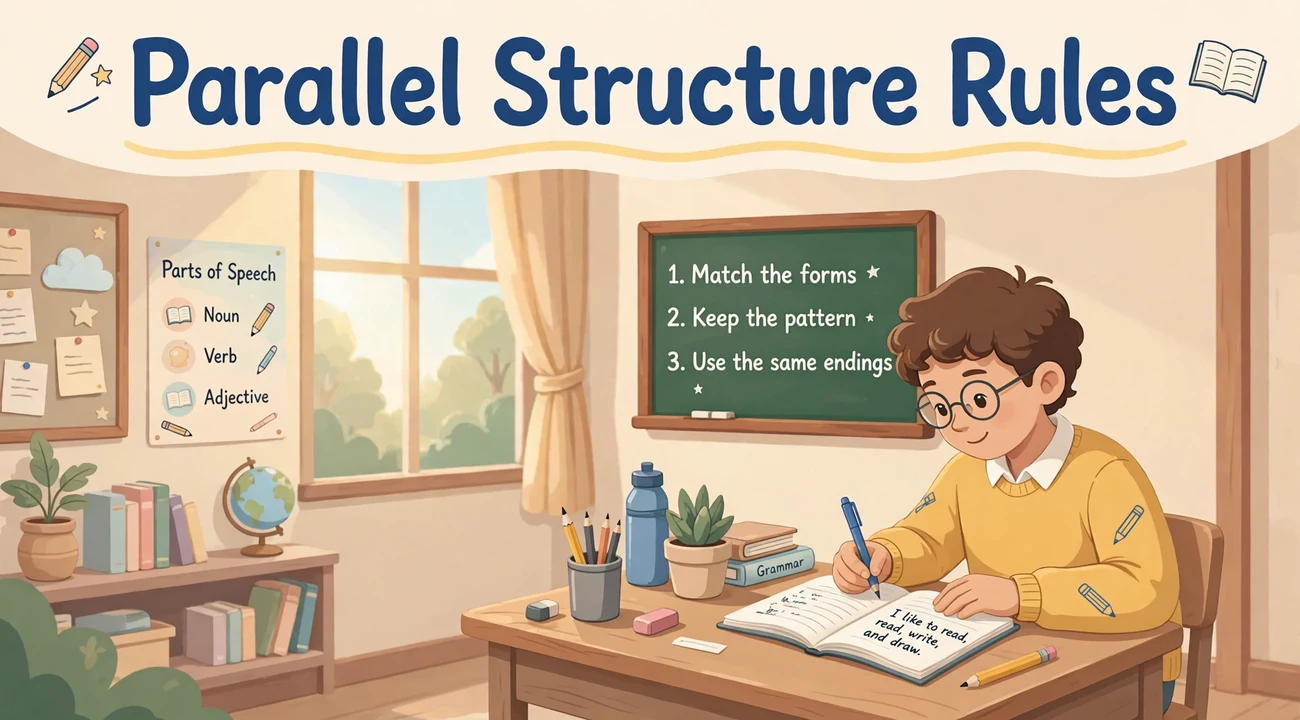
These seven rules cover almost every problem of this kind. Learn them once, and fixing a broken pattern becomes easy.
Rule 1: Words in a List Must Use the Same Form
A list is the most common place for a broken pattern. If the first item is an -ing word, the rest must be too. I enjoy reading, writing, and to draw. breaks the rule. Fix it: I enjoy reading, writing, and drawing.
Rule 2: Paired Words Must Match, Too
A pair is only two parts, but the same rule applies. She is both smart and works hard. mixes an adjective with a verb, so it feels wrong. Fix it: She is both smart and hard-working. Pairs use words like both/and, either/or, neither/nor, and not only/but also. See our guide to conjunctions.
Rule 3: Comparisons Need the Same Form on Both Sides
When you compare two things, both sides must use the same form. To win is better than losing. compares an infinitive with an -ing word, so it is not parallel. Fix it: Winning is better than losing.
Rule 4: After and, or, and but, Keep the Same Form
The words and, or, and but join parts that do the same job, so those parts must match. He came, saw, and was conquering. mixes two past verbs with a longer form. Fix it: He came, saw, and conquered.
Rule 5: Match the Form After Prepositions
After a preposition like by, with, or for, the form must stay the same. She learned by reading, by watching, and to listen. breaks the pattern at the end. Fix it: She learned by reading, by watching, and by listening. You can drop the repeated word, but the -ing form must stay. See our guide to prepositional phrases.
Rule 6: Repeat the Word That Starts the Pattern
Sometimes, repeat a small word. I like that he reads and writes well. is fine, but I like that he reads and that he writes well. is clearer, because that starts both parts. The same trick works with infinitives: She wants to sing and to dance. is clearer than She wants to sing and dance. See our guide to infinitives.
Rule 7: Read the Sentence Aloud and Listen for the Bump
Your ear often catches what your eye misses. Read the list aloud, and listen for the part that sounds different. If one part feels off in shape, it is probably the break.
40 Parallel Structure Examples
Here are 40 examples of parallel structure: the first 20 are broken sentences, and the next 20 show the same ideas fixed.
Not parallel (wrong on their own):
- She likes reading, writing, and to swim.
- He is smart, kind, and works hard.
- To win is better than losing.
- I enjoy to run, jumping, and swimming.
- The book is long, dull, and costs a lot.
- She wants to sing, dancing, and to act.
- He came, saw, and was conquering.
- I like tea more than drinking coffee.
- She is both smart and works hard.
- We need to study, to practise, and sleeping well.
- The room was clean, quiet, and smelled nice.
- He likes to fish, hunting, and camping.
- Reading is fun, writing is hard, to speak is scary.
- She learned by reading, watching, and to listen.
- He is either home or goes to work.
- The dog is big, strong, and barks.
- I want a fast, cheap car that looks good.
- She neither called nor she wrote a letter.
- To learn is good, to teach is better, practising is best.
- He asked for help, advice, and to be left alone.
Fixed with parallel structure:
- She likes reading, writing, and swimming.
- He is smart, kind, and hard-working.
- Winning is better than losing.
- I enjoy running, jumping, and swimming.
- The book is long, boring, and costly.
- She wants to sing, dance, and act.
- He came, saw, and conquered.
- I like tea more than coffee.
- She is both smart and hard-working.
- We need to study, practise, and sleep well.
- The room was clean, quiet, and fresh.
- He likes to fish, hunt, and camp.
- Reading is fun, writing is hard, speaking is scary.
- She learned by reading, watching, and listening.
- He is either at home or at work.
- The dog is big, strong, and loud.
- I want a fast, cheap, good-looking car.
- She neither called nor wrote a letter.
- Learning is good, teaching is better, practising is best.
- He asked for help, advice, and time alone.
For a deeper look, the Wikipedia article on parallelism explains the same idea.
Common Parallel Structure Mistakes
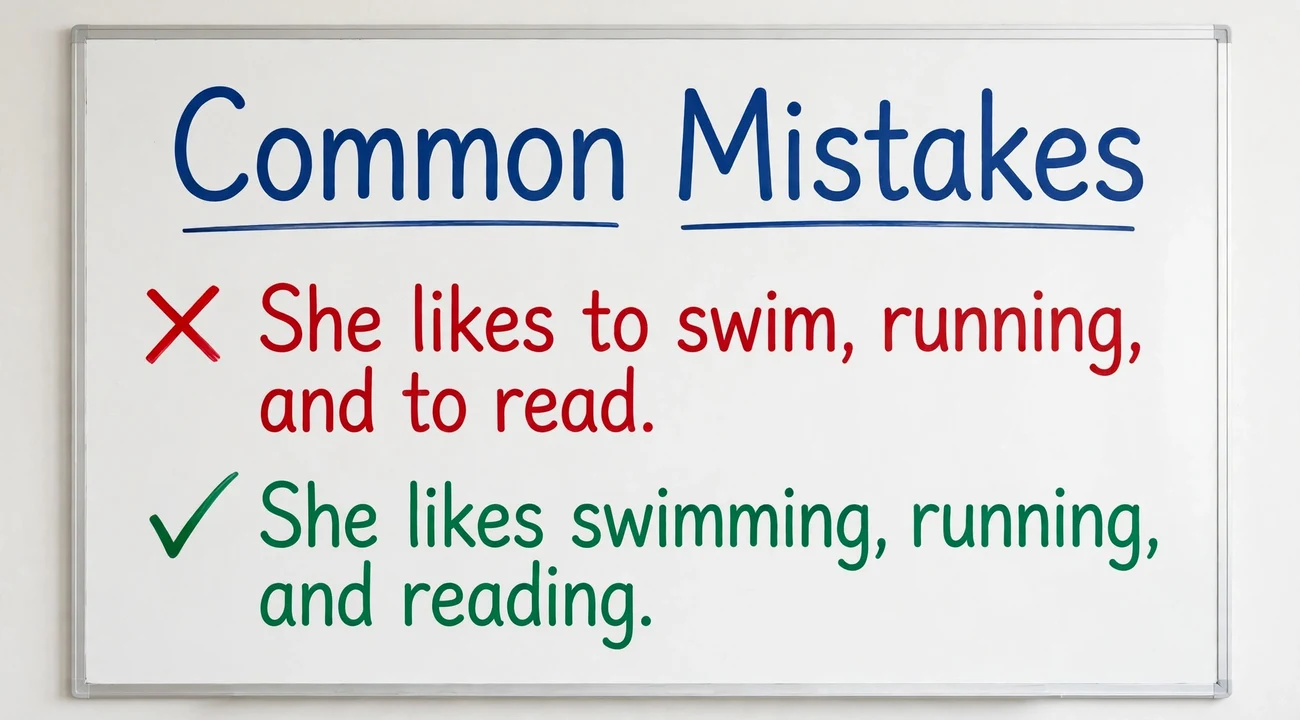
Even good writers make these mistakes. Learn them once.
Mistake 1: Mixing -ing words with infinitives. Wrong: I like swimming and to run. Right: I like swimming and running. Keep the form the same through the whole list. This is the most common break in essays, emails, and exam answers.
Mistake 2: Mixing adjectives with verbs. Wrong: She is kind, smart, and helps others. Right: She is kind, smart, and helpful. An adjective must match an adjective.
Mistake 3: Forgetting the second half of a pair. Wrong: He is not only smart but works hard. Right: He is not only smart but also hard-working. After not only, but also needs a part in the same form as the first one.
Mistake 4: Comparing two different forms. Wrong: To read is more fun than watching films. Right: Reading is more fun than watching films. Both sides of a comparison must use the same form. See our guide to subject-verb agreement.
Quick Quiz: Parallel or Not Parallel?
Read each sentence. Is it parallel or not? Answers are at the end!
- She likes to read, to write, and to draw.
- He is tall, strong, and runs fast.
- I enjoy cooking, cleaning, and washing.
- She wants a job that pays well and fun.
- To swim is better than to run.
Answers: 1. Parallel – all three parts are infinitives. 2. Not parallel – He is tall, strong, and fast. 3. Parallel – all three are -ing words. 4. Not parallel – She wants a job that pays well and is fun. 5. Parallel – both sides are infinitives.
How did you do? 5/5 – excellent! 4 – very good. Fewer than 4 – read the 2-second test again.
FAQs About Parallel Structure
| Question | Short Answer |
|---|---|
| What is parallel structure? | Matching forms |
| Where does it show up? | Lists, pairs, comparisons |
| How do I find a break? | Check each part’s form |
| How do I fix a break? | Change the odd part |
What is parallel structure in simple words?
Parallel structure means parts of a sentence with the same job must use the same form. Reading, writing, and swimming is parallel, because all three parts are -ing words. Reading, writing, and to swim is not, because the last part breaks the pattern.
How can I find a parallel structure mistake in my writing?
Look for lists, pairs, and comparisons. Then check the form of each part – if one part is different, you have found the break. Reading aloud helps.
Is She likes to read and swimming parallel?
No. To read is an infinitive and swimming is an -ing word, so the parallel structure is broken. Fix it: She likes to read and to swim. or She likes reading and swimming.
Are parallel structure mistakes always wrong?
In essays, exams, and formal emails, yes – fix them. In songs and ads, writers sometimes break the pattern on purpose, but in school and work writing, keep it even.
What is the difference between parallel structure and a sentence fragment?
It is about matching forms, while a sentence fragment is an incomplete sentence missing a subject, a verb, or a thought. A sentence can be parallel and still be a fragment. See our guide to sentence fragments.
Do I need parallel structure in every sentence?
No. You only need it when a sentence has parts that share the same job – a list, a pair, or a comparison.
Conclusion
Parallel structure is a small change with a big effect. Check the parts that share the same job – if one part has a different form, change it to match the rest.
Practise with the examples and quiz here, and soon you will spot a broken pattern. For more simple lessons, keep learning with GrammarLuck.
