

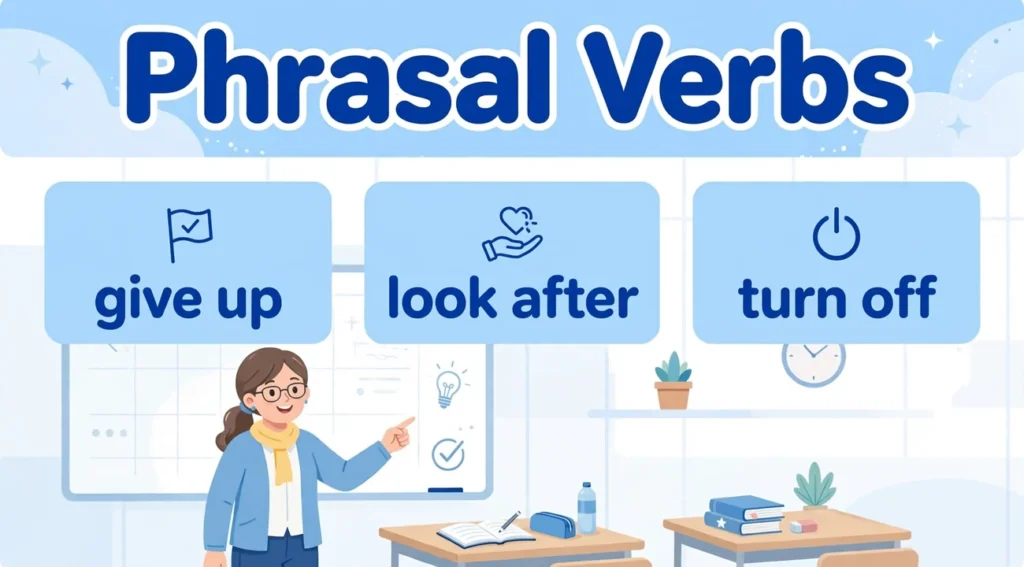
Phrasal verbs are one of the most useful parts of everyday English. You hear them in films, songs, and daily chats. A phrasal verb is a verb plus a small word, like up, down, or out, and together they make a new meaning. In this GrammarLuck guide, you will learn what phrasal verbs are and how to use them.
The short answer is simple. A phrasal verb joins a main verb with a particle, and the pair takes on a meaning that is often very different from the verb alone. For example, give up does not mean to give something upwards — it means to stop trying. Look after does not mean to look behind something — it means to take care of someone. Learn the most common phrasal verbs, and your English will sound far more natural.
In this complete guide, you will learn the meaning of phrasal verbs, 7 simple rules, a 2-second memory trick, 40 clear examples, common mistakes, and a quick quiz. By the end, phrasal verbs will feel easy, and you will use them every day.
The quick answer: a phrasal verb is a verb + a particle, and the pair has one new meaning.
| Phrasal Verb | Meaning | Example |
|---|---|---|
| give up | stop trying | Don’t give up on your dreams. |
| look after | take care of | She looks after her little brother. |
| run out of | have none left | We ran out of milk. |
Notice how the meaning of each phrasal verb is new — you cannot guess it from the two words alone.
What Are Phrasal Verbs?

A phrasal verb is a verb plus a particle. The particle is usually a small word such as up, down, in, out, on, off, or away. Together they form one unit. For example, break down means to stop working, and pick up means to lift. Learn them as whole units, not as single words.
English has thousands of phrasal verbs, but about 100 common ones cover most daily talks — start with those.
Separable and Inseparable Phrasal Verbs
Some phrasal verbs are separable, which means you can place the object between the verb and the particle. You can say “turn the light off” or “turn off the light” — both are correct. Other ones are inseparable, so the object must come after the particle. You say “look after the baby”, never “look the baby after”.
- Separable: turn off, pick up, put on, take off, throw away.
- Inseparable: look after, run into, get on with.
Transitive and Intransitive Phrasal Verbs
Some need an object, and some do not. A transitive one needs an object — you pick up something. An intransitive one needs no object — you simply wake up.
| Type | Needs an Object? | Example |
|---|---|---|
| Transitive | Yes | Please pick up the bag. |
| Intransitive | No | I wake up at six every day. |
Why English Uses So Many Phrasal Verbs
Native speakers use phrasal verbs because they are short, friendly, and natural. “Put out the fire” sounds warmer than “extinguish the fire”. That is why learners who know these verbs sound more fluent, even with a small vocabulary. If you are still building your base, start with our guide to verbs and then return here.
7 Simple Phrasal Verbs Rules
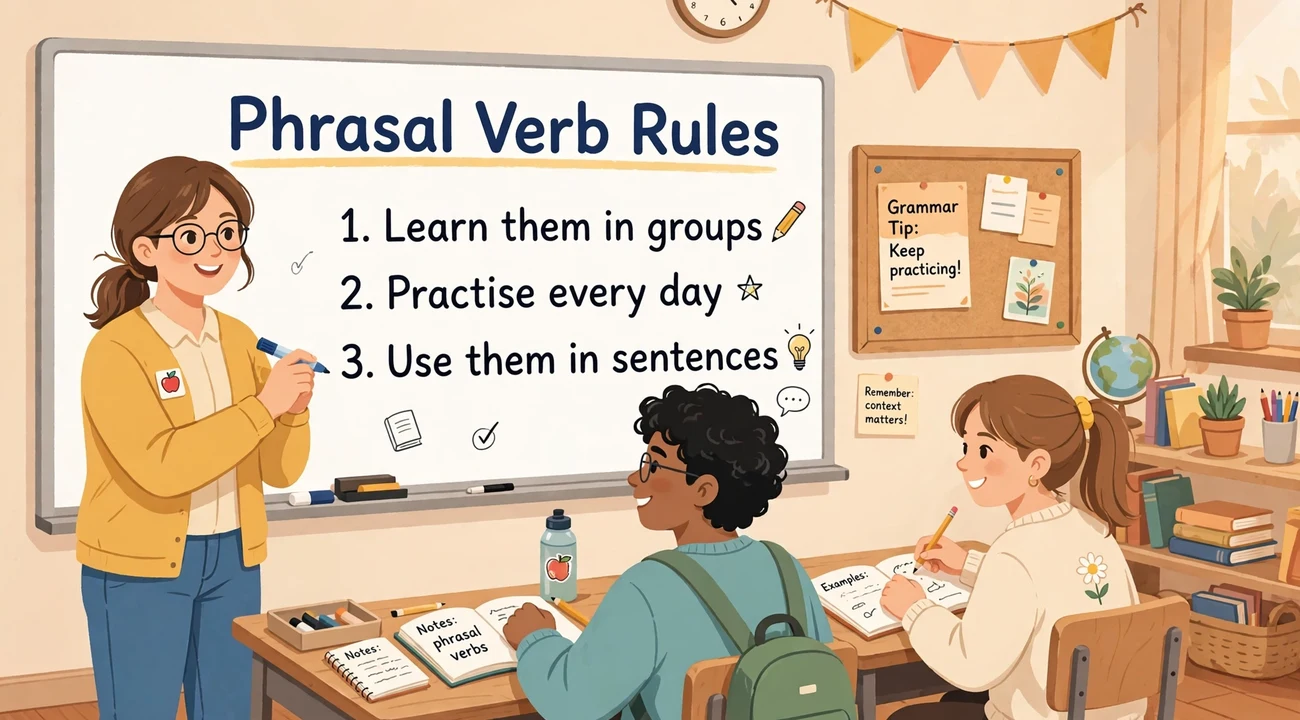
These 7 rules cover almost everything you need to use them with confidence. Read them slowly and try the examples aloud.
Rule 1: Learn the Whole Unit, Not the Two Words
Learn give up as one piece that means “stop trying”, and look into as one piece that means “study or check”. Store the whole unit in your mind, and the meaning stays clear.
Rule 2: Check If It Is Separable or Inseparable
Check if you can split it. With separable verbs like put on, the object can sit in the middle: “Put your coat on.” With inseparable verbs like look for, the object stays after the particle: “I am looking for my keys.”
Rule 3: Watch the Tense of the Main Verb
Only the main verb changes with tense — the particle never changes. You say “He gave up” and “They have run out of time.” Practise this with the present simple tense first, and then try the present perfect tense with the same verbs.
Rule 4: Learn What the Particle Adds
Up often means “finish” (eat up, clean up). Out often means “to the end” (find out, work out). Off often means “away” or “stop” (switch off, take off). These hints help, but always check the full meaning. Many particles are also prepositions.
Rule 5: Use Them in Real Sentences
A verb learned from a list is easy to forget, but one used in your own sentence stays with you. Write three short sentences for every new one you learn. Try different types of sentences — a statement, a question, and a command.
Rule 6: Practise a Little Every Day
Five minutes a day beats one long session a week. Pick two new phrasal verbs each morning, use them in a short chat or a note, and review them the next day. You can test yourself with our free grammar exercises whenever you want a quick check.
Rule 7: Learn Them in Groups by Topic
Learn travel verbs together (set off, check in, take off), work verbs together (take over, carry out, hand in), and daily-life verbs together (wake up, get dressed, clean up). A group gives your memory a hook.
The 2-Second Phrasal Verbs Trick
Here is a fast trick to remember phrasal verbs. First, picture the action in your mind — see yourself giving up a heavy bag, or looking after a small child. Second, say the verb and its one-word meaning out loud: “give up — quit”, “look after — care”. A clear picture plus a one-word meaning takes two seconds and locks the verb in your memory.
40 Phrasal Verbs Examples
Here are 40 simple examples. Read them aloud, and try to make your own sentence with each one. For a deeper look at the history of these forms, read Wikipedia’s guide to these verbs.
Examples 1–20:
- Turn off the lights before you leave.
- Don’t give up now.
- She looks after her little brother every evening.
- We ran out of milk this morning.
- He turned up late for class.
- Can you pick up my bag?
- I need to put off the meeting.
- The old car broke down yesterday.
- She put on her coat and went out.
- Please take off your shoes here.
- They set off early to catch the train.
- I will look into the problem today.
- He gave in and helped us.
- We need to work out a plan.
- She found out the truth today.
- Please clean up your room now.
- Hand in your homework on time.
- He woke up at six today.
- They got on the bus quickly.
- Please switch on the fan.
Examples 21–40:
- She took off her hat and smiled.
- We look forward to meeting you.
- He ran into an old friend today.
- Please fill in this form now.
- The plane took off on time.
- I came across a great book yesterday.
- She called off the party.
- He carried on working after midnight.
- We checked in at the hotel.
- Please throw away the old papers.
- They put up a tent by the river.
- He turned down the job offer.
- She brought up three children alone.
- We need to go over the lesson.
- He passed away many years ago.
- Can you look up this word?
- They moved out of the old house.
- She stood up and answered quickly.
- We ate up all the food.
- He held on to the rope.
Common Phrasal Verbs Mistakes
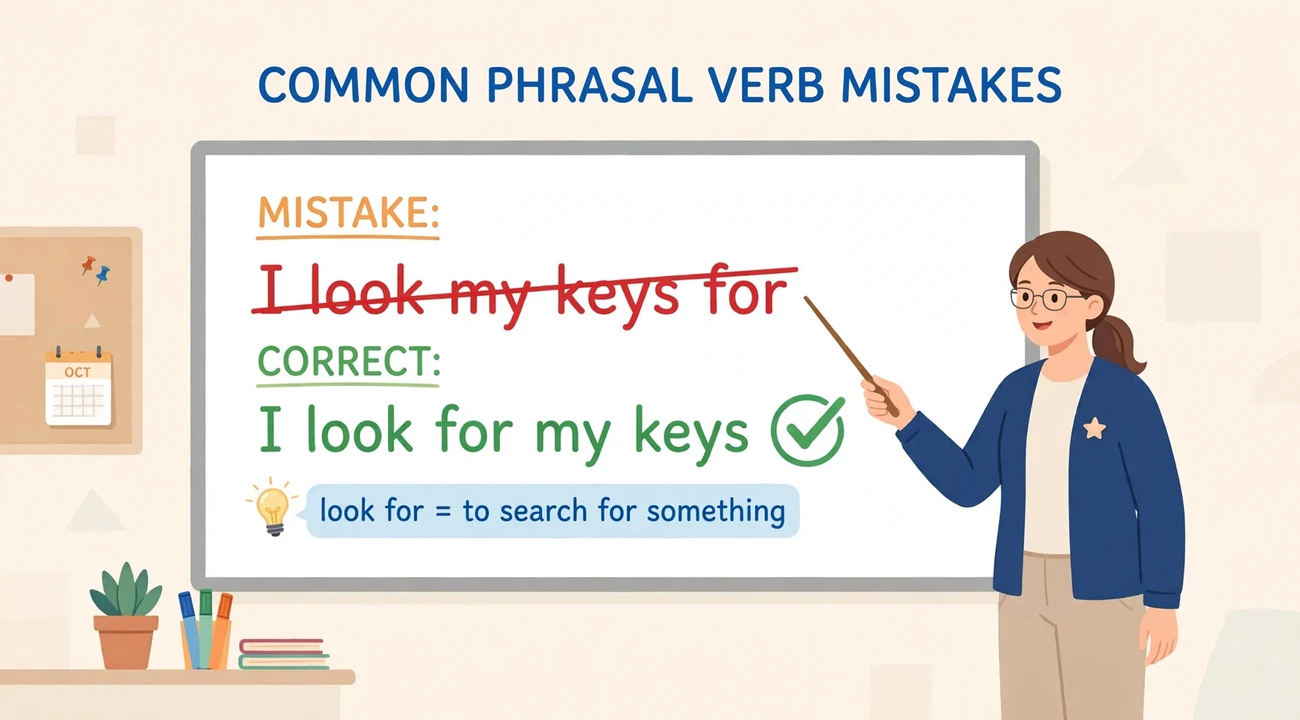
Even good learners make these mistakes.
Mistake 1: Splitting an inseparable phrasal verb.
Wrong: “She looks her brother after.” Right: “She looks after her brother.” With inseparable verbs, the object always comes after the particle.
Mistake 2: Using the wrong particle.
Wrong: “Please look up the baby.” Right: “Please look after the baby.” Look up means to search for facts, while look after means to take care of someone.
Mistake 3: Guessing the meaning from the two words.
Wrong: “He gave up the box” (to mean he lifted it). Right: “He gave up smoking.” Give up means to stop or quit — it never means to lift. Always learn the full meaning.
Mistake 4: Forgetting the object with a transitive verb.
Wrong: “Please pick up.” Right: “Please pick up the bag.” Transitive verbs need an object, or the sentence feels unfinished.
Quick Quiz: Phrasal Verbs
Choose the correct phrasal verb for each sentence. Answers are at the end — no peeking!
- I need to ___ the meeting until next week. (put off / put on)
- She ___ her little sister while their mother is away. (looks after / looks up)
- Please ___ the lights when you leave the room. (turn off / turn up)
- We ___ of sugar, so I bought some more. (ran out / ran into)
- He ___ early this morning to catch the train. (set off / gave up)
- Can you ___ this word in the dictionary? (look up / look after)
Answers:
1. put off — delay
2. looks after — care
3. turn off — switch off
4. ran out — none left
5. set off — leave
6. look up — search
How did you do? 6/6 — excellent, you have mastered them! 4–5 — very good. Fewer than 4 — read the rules once more and try again.
Phrasal Verbs: Quick Summary
| Point | What It Means | Example |
|---|---|---|
| Meaning | Verb + particle with one new meaning | give up = stop trying |
| Separable | Object can sit in the middle | Turn the light off. |
| Inseparable | Object stays after the particle | Look after the baby. |
| Transitive | Needs an object | Pick up the bag. |
| Intransitive | Needs no object | I wake up at six. |
| Tense | Only the main verb changes | He gave up yesterday. |
The answer is simple: learn each one as a whole unit, check if it splits, and use it in your own sentences.
FAQs About Phrasal Verbs
What are phrasal verbs in simple words?
They are a verb plus a small word, like up or out, that together make a new meaning — give up means to stop trying.
How many should I learn first?
Start with the 40 in this guide. About 100 common ones cover most daily English, so learn a few each week.
Are they formal or informal?
They are friendly and common in daily talk, emails, and films. In very formal writing, a one-word verb can fit better — “delay” instead of “put off”.
Can a phrasal verb have more than one meaning?
Yes. For example, take off can mean to remove clothes, to fly in a plane, or to become popular. The sentence around it shows which meaning is right.
What is the difference between a phrasal verb and a prepositional verb?
In a phrasal verb, the particle changes the meaning of the verb, like give up. In a prepositional verb, the verb keeps its normal meaning and the preposition links it to an object, like look at the picture.
How can I remember them easily?
Use the 2-second trick from this guide: picture the action, then say the verb with its one-word meaning, like “give up — quit”. Learn them in topic groups and use each new verb in three of your own sentences.
Conclusion
Phrasal verbs are small, but they carry a lot of power. One verb plus one small word can change a whole sentence. Learn them as whole units, check if they split, and use them daily.
Practise with the examples and quiz here, and soon you will use phrasal verbs without even thinking. For more simple lessons, keep learning with GrammarLuck — grammar made simple.
