

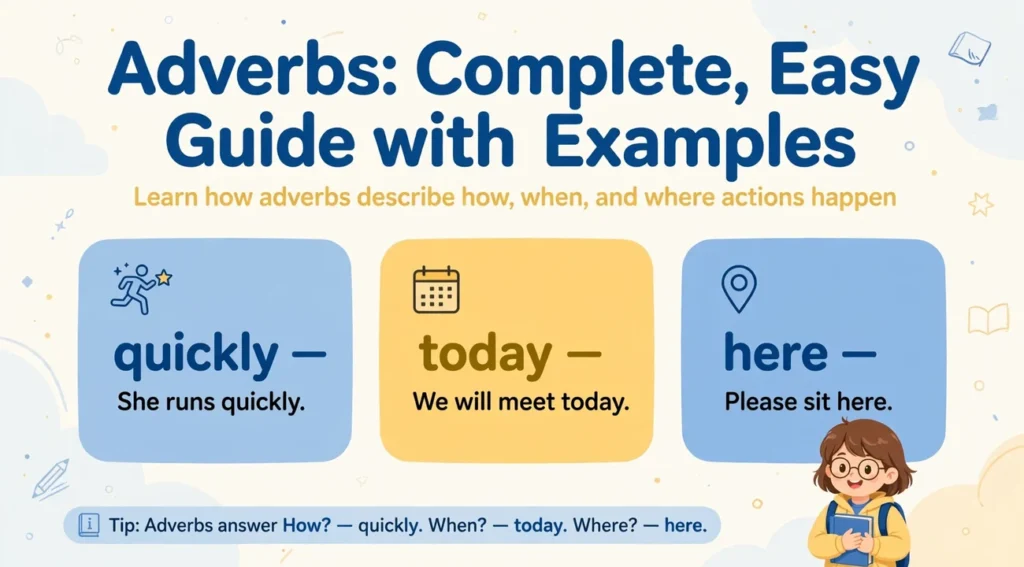
Adverbs are words that describe a verb, an adjective, or another adverb. Words like quickly, today, here, always, and very are adverbs. They tell us how, when, where, or how often an action happens. In this guide, you will learn the meaning, 5 simple rules, a 2-second trick, 40 examples, common mistakes, and a quick quiz.
Many learners know adjectives, but they are not sure how they differ. “She is quick” and “She runs quickly” do not work the same way. Quick describes her, while quickly describes how she runs. The good news is that they follow a few clear patterns, and once you learn the five main types, you will pick the right word most of the time.
In this complete guide, you will learn what they are, the 5 simple rules, a 2-second trick, 40 examples, the most common mistakes, and a quick quiz. By the end, you will use these adverbs — quickly, today, here, always, and very — with confidence.
Adverbs: The Quick Answer
The fastest way to learn them is to see the five main types side by side. The type tells you which word to pick.
| Type | Asks | Words | Example |
|---|---|---|---|
| Manner | How? | quickly, slowly, well | She runs quickly. |
| Time | When? | today, now, later | We will meet today. |
| Place | Where? | here, there, outside | Please sit here. |
| Frequency | How often? | always, often, never | He always comes on time. |
| Degree | How much? | very, quite, too | It is very hot today. |
The golden rule: ask “how, when, where, or how often?” first. The question tells you the type, and the type tells you the word. Learn the question first, and the word follows.
What Are Adverbs?
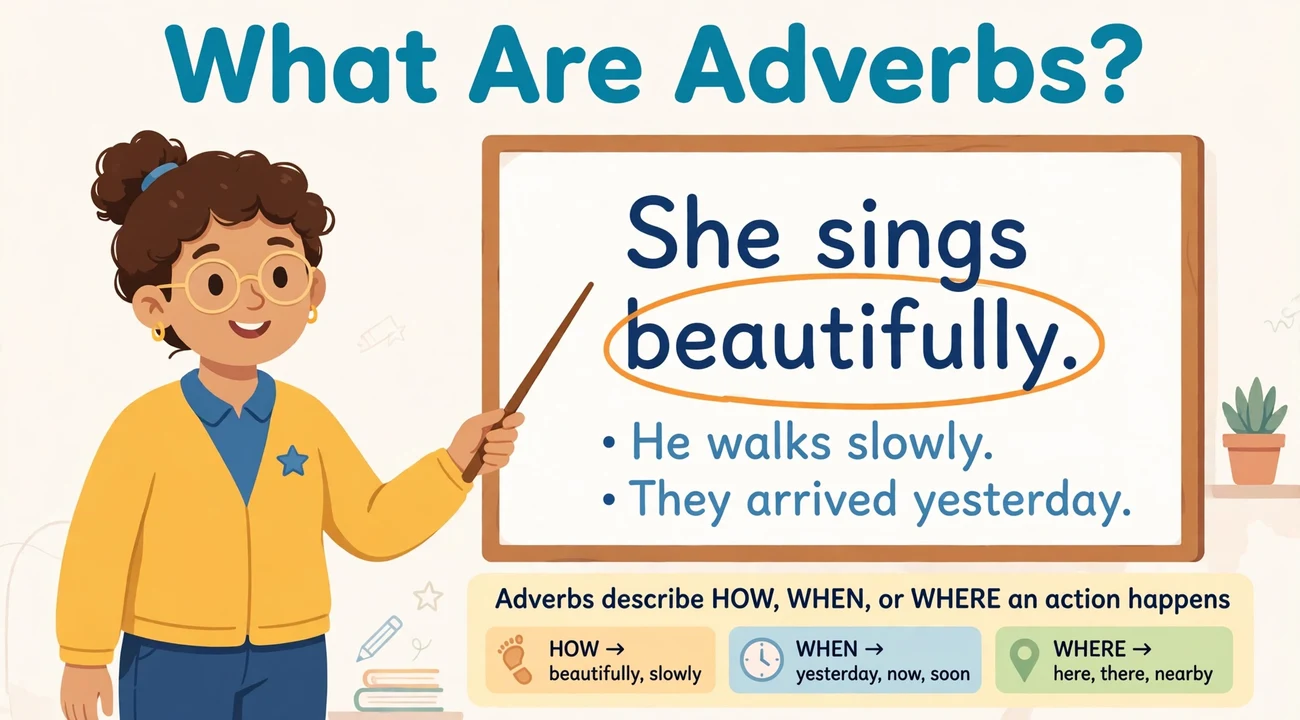
An adverb is a word that adds more meaning to a verb, an adjective, or another adverb. In “She sings beautifully,” the word beautifully tells us how she sings. In “It is very cold,” the word very tells us how cold it is. Without them, our sentences feel plain and flat.
Adverbs do five main jobs. They tell us how an action happens (quickly), when it happens (today), where it happens (here), how often it happens (always), and how much (very). Many manner words end in -ly, such as slowly, softly, and carefully, but not all of them do. Words like fast, well, hard, and now belong to this group too, even without -ly.
Read our guide to prepositions to see how small words show place and time in a sentence. For a refresher on the basic tenses, start with our guide to the present simple tense.
| Type | Words | Example |
|---|---|---|
| Manner | quickly, slowly, well, loudly | She speaks softly. |
| Time | today, now, later, yesterday | We met yesterday. |
| Place | here, there, outside, everywhere | They looked everywhere. |
| Frequency | always, often, sometimes, never | She sometimes walks to school. |
| Degree | very, quite, too, almost | He is quite tall. |
| Question | how, when, where, why | When will you come? |
Start with quickly, today, here, always, and very. These five words cover most of the sentences you will write each day.
5 Simple Adverbs Rules

These five rules cover most of the mistakes learners make with them. Learn them one by one. Each rule below works in all types of sentences.
Rule 1: Use -ly to Make Manner Words from Adjectives
Most manner words come from adjectives. Add -ly to the adjective, and you get the word you need. Quick becomes quickly, slow becomes slowly, and careful becomes carefully. This is the most common way to build one.
- She runs quickly to catch the bus.
- He speaks slowly so we can understand him.
- Please write your name carefully on the form.
Rule 2: Put Manner Words After the Verb or After the Object
Put an adverb of manner after the verb, or after the object if the verb has one. “She sings beautifully” puts the adverb after the verb. “He reads the book carefully” puts it after the object. Do not put it between the verb and its object.
- She sings beautifully at the concert.
- He reads the book carefully every night.
- They played the game well yesterday.
Rule 3: Put Frequency Words Before the Main Verb
Adverbs of frequency, like always, often, and never, go before the main verb in a simple sentence. “She always comes on time” puts always before comes. With the verb be, they go after it: “He is always late.”
- She always comes on time.
- We often play football on Sunday.
- He is never late for school.
Rule 4: Do Not Use an Adjective After a Verb
After a verb, use an adverb, not an adjective. “She runs quick” is wrong, because quick is an adjective and runs is a verb. The right form is “She runs quickly.” A few verbs, like be, seem, look, and feel, take an adjective instead, as in “She looks happy.”
- She runs quickly, not quick.
- He speaks English fluently, not fluent.
- The baby slept peacefully all night.
Rule 5: Some Words Have the Same Form as Adjectives
A few words stay the same in both jobs. Fast, hard, early, and late never change form. “A fast car” uses fast as an adjective, and “He runs fast” uses fast as an adverb. Never add -ly to these words.
- He runs fast every morning.
- She works hard at her studies.
- The train arrived early today.
The 2-Second Adverbs Trick
Still not sure whether a word is an adverb? Ask yourself one question: “Does it tell how, when, where, or how often?”
Step 1: Find the verb in the sentence.
Step 2: Ask how, when, where, or how often the action happens.
Step 3: If the word answers one of those questions, it is an adverb.
Try the trick on these sentences:
- “She sings ___.” — beautifully tells how she sings, so it is an adverb.
- “We will meet ___.” — today tells when we meet, so it is an adverb.
Keep this trick in mind, and the choice will soon feel natural. Most of them become easy once you ask the right question first.
40 Adverbs Examples
Here are 40 simple examples — the first 20 use manner and time words, and the next 20 use place, frequency, and degree words.
Adverbs of manner and time:
- She runs quickly to school.
- He speaks slowly and clearly.
- They played the game well.
- She sings beautifully.
- Please listen carefully to the teacher.
- The baby slept peacefully all night.
- He drives safely on the road.
- She smiled happily at her friend.
- We finished the work easily.
- He answered the question correctly.
- We will meet today after lunch.
- She came yesterday to visit us.
- I will call you later tonight.
- He arrived early this morning.
- They are leaving now for the market.
- She will come tomorrow with her sister.
- We met last week at the park.
- He finished his work just now.
- She reads a book every day.
- They will start soon after breakfast.
Place, frequency, and degree:
- Please sit here next to me.
- They looked everywhere for the keys.
- Come outside and play with us.
- She stayed there all day.
- He walked upstairs to his room.
- The children are playing nearby.
- She always comes on time.
- We often visit our grandparents.
- He never tells a lie.
- She sometimes walks to school.
- They rarely watch television at night.
- I usually drink tea in the morning.
- It is very hot today.
- She is quite good at English.
- The tea is too sweet for me.
- He is almost ready to leave.
- We are nearly there now.
- She sings so beautifully.
- He worked really hard all day.
- I am just tired, nothing more.
Use these sentences in your own writing. For more short sentences, see our guide to comma rules to punctuate them well. For the full grammar background, read Adverb on Wikipedia.
Common Adverbs Mistakes
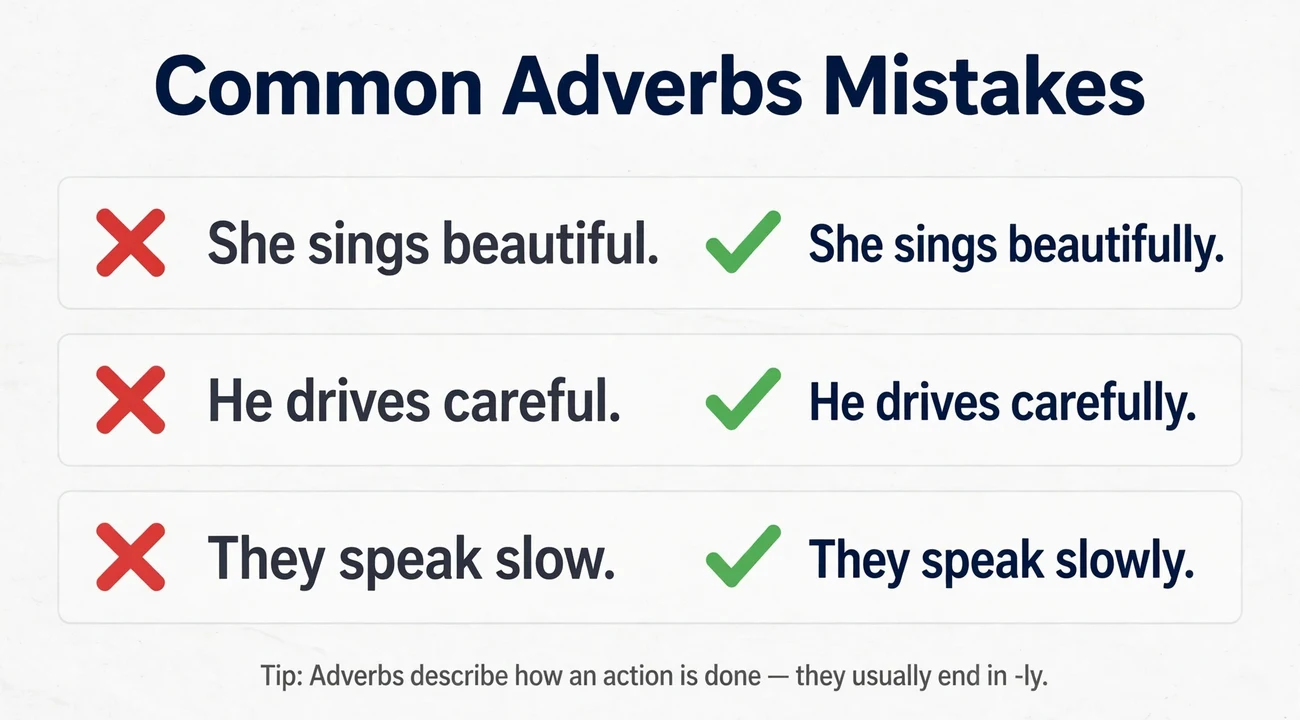
Even good learners make these mistakes. Learn them once and avoid them for life.
Mistake 1: Using an adjective after a verb.
Wrong: “She runs quick.” Right: “She runs quickly.” After a verb, use an adverb, not an adjective.
Mistake 2: Putting the adverb between the verb and its object.
Wrong: “He reads carefully the book.” Right: “He reads the book carefully.” The adverb goes after the object, not between the verb and the object.
Mistake 3: Putting adverbs of frequency in the wrong place.
Wrong: “She comes always on time.” Right: “She always comes on time.” Always goes before the main verb, not after it.
Mistake 4: Using “good” instead of “well.”
Wrong: “He speaks English good.” Right: “He speaks English well.” Good is an adjective, and well is the adverb you need after a verb.
Mistake 5: Adding -ly to “fast” or “hard.”
Wrong: “He runs fastly.” Right: “He runs fast.” Fast and hard stay the same in both jobs, so never add -ly to them.
Practise these fixes with short drills, and read our guide to its vs it’s to fix another common mix-up.
Quick Quiz: Adverbs
Fill in the blank with the right adverb — answers are below!
- She runs ___ to catch the bus. (quick / quickly)
- We will meet ___ after lunch. (today / now)
- Please sit ___ next to me. (here / there)
- He ___ comes on time. (always / never)
- It is ___ hot today. (very / much)
- He speaks English ___. (good / well)
- She reads the book ___. (careful / carefully)
- They looked ___ for the keys. (everywhere / anywhere)
Answers:
1. quickly
2. today
3. here
4. always
5. very
6. well
7. carefully
8. everywhere
How did you do? 8/8 — excellent! 6–7 — very good. Fewer than 6 — read the trick once more.
Adverbs: Quick Summary
| Type | Asks | Words | Example |
|---|---|---|---|
| Manner | How? | quickly, slowly, well | She runs quickly. |
| Time | When? | today, now, later | We will meet today. |
| Place | Where? | here, there, outside | Please sit here. |
| Frequency | How often? | always, often, never | He always comes on time. |
| Degree | How much? | very, quite, too | It is very hot today. |
Adverbs feel hard for a week — then easy for life.
FAQs About Adverbs
What are adverbs in simple words?
Adverbs are words like quickly, today, here, always, and very. They describe a verb, an adjective, or another adverb, and they tell us how, when, where, or how often an action happens.
What is the difference between an adjective and an adverb?
An adjective describes a noun, as in “a quick run.” An adverb describes a verb, an adjective, or another adverb, as in “She runs quickly.”
What are the 5 types of adverbs?
The five types are manner (quickly), time (today), place (here), frequency (always), and degree (very). Each type answers a different question about the action.
Where do adverbs go in a sentence?
Manner words go after the verb or after the object, as in “She sings beautifully.” Adverbs of frequency go before the main verb, as in “She always comes on time,” and after the verb be, as in “He is always late.”
Do all adverbs end in -ly?
No. Many do, like quickly and slowly, but some common ones do not, like fast, well, hard, today, here, and now. Fast and hard stay the same as both adjectives and adverbs.
How can I learn adverbs fast?
Learn the five types from the tables in this guide, say the examples aloud, and do the quiz each day. The 2-second trick in this guide will help you spot them in any sentence.
Conclusion
Adverbs are smaller than they look. Five types and five simple rules cover most sentences you will ever write. Remember that quickly tells how, today tells when, here tells where, always tells how often, and very tells how much.
Practise with the examples and quiz in this guide, and soon you will choose the right word without thinking. Keep building your grammar with our guide to subject-verb agreement, and keep learning with GrammarLuck — grammar made simple.
